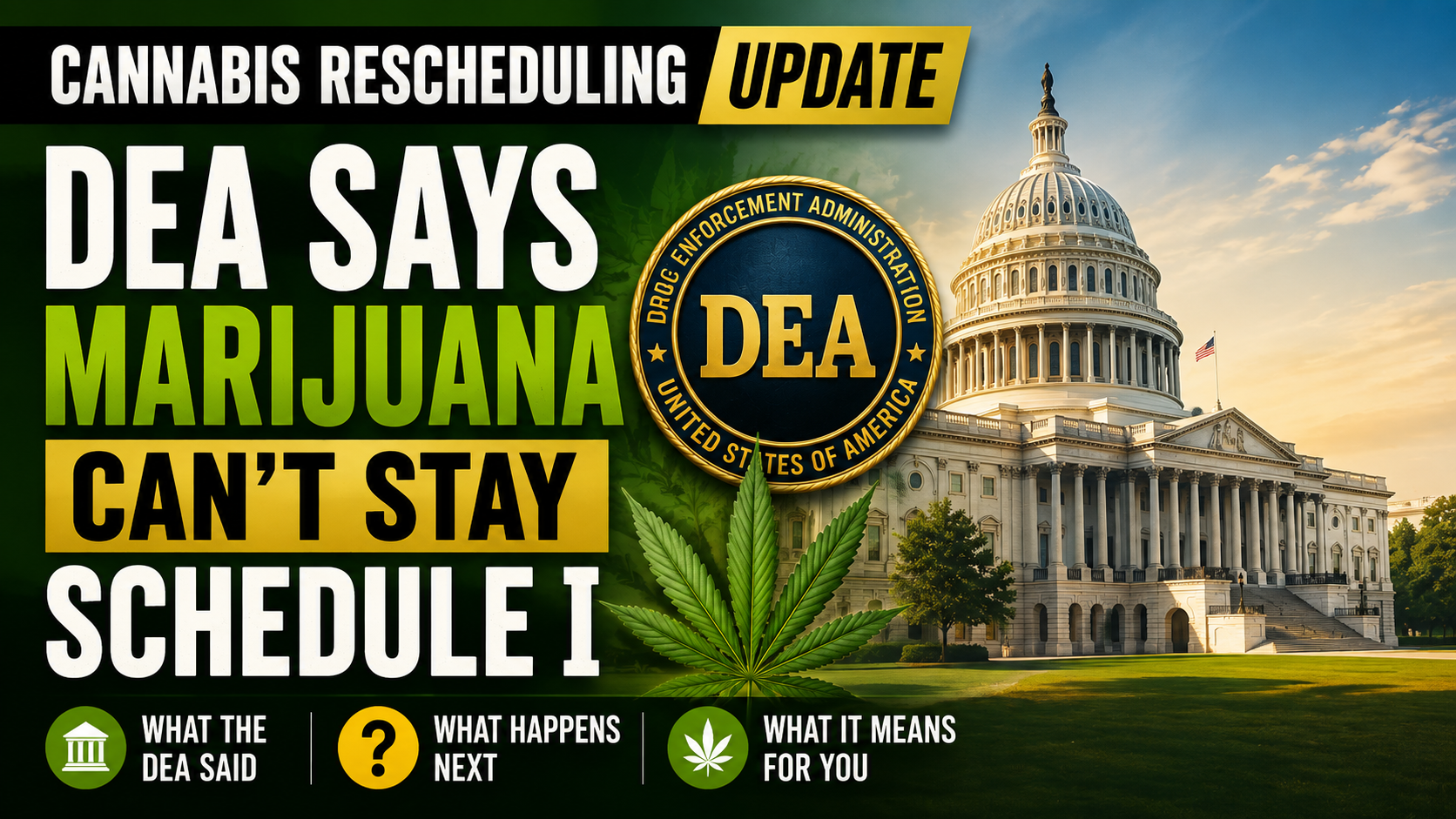
Two major cannabis policy stories are converging today. At the federal level, the newly released DEA marijuana rescheduling hearing record shows government attorneys making the case that marijuana can no longer remain in Schedule I. Here in Ohio, a replacement packaging and labeling rule points toward the removal of the one-year expiration-date requirement for cannabis plant material. Both developments could have real consequences for patients, consumers, cannabis operators and the broader industry.
Ohio Cannabis Live is breaking both stories down on today’s live stream, Cannabis Rescheduling Update: DEA Says Marijuana Can’t Stay Schedule I. We are separating what has actually changed from what is still moving through the regulatory process, and what all of it could mean for Ohio.
DEA: Marijuana Can No Longer Remain in Schedule I
The federal marijuana rescheduling process has reached another important point. The official hearing transcript has been released, giving the public a much clearer look at the arguments made during the proceeding. Government attorneys argued that the evidence supports a currently accepted medical use for marijuana and that marijuana therefore can no longer remain in Schedule I.
That is significant, but it does not mean marijuana has already been broadly moved to Schedule III. The administrative process is still underway. The judge overseeing the hearing is expected to issue a recommended decision, and the final federal action has not yet been completed.
That distinction matters. Rescheduling and legalization are not the same thing. A move to Schedule III would still leave marijuana controlled under federal law. It would not automatically create nationwide adult-use legalization or erase the differences between state and federal cannabis laws.
Why Schedule III Could Matter
Even without full legalization, a broader move to Schedule III could have major consequences for the cannabis industry. One of the biggest questions is federal taxation. Cannabis businesses have long operated under Internal Revenue Code Section 280E, which blocks many ordinary business deductions for companies trafficking in Schedule I or Schedule II controlled substances. If marijuana is broadly moved to Schedule III, that tax treatment could change in a major way.
Rescheduling could also reduce some barriers to cannabis research and further formalize marijuana’s accepted medical use at the federal level. At the same time, businesses, patients and consumers should not assume every federal cannabis problem disappears the moment a scheduling change takes effect. Banking, interstate commerce, criminal law and state licensing would still involve separate legal questions.
Ohio Is Moving Away From Flower Expiration Dates
Ohio has its own important cannabis rule change developing. Under the current Ohio Administrative Code, cannabis plant material is labeled with an expiration date that cannot exceed one calendar year from the date of harvest.
The replacement packaging and labeling rule filed by the Ohio Division of Cannabis Control changes that structure. The new plant-material labeling section continues to require key information including the harvest date, package date, strain name, net weight, THC information, testing information and batch tracking details, but the expiration-date requirement is not carried forward in that section.
The important caution is timing. The current one-year rule remains the rule until the replacement rule becomes effective. So the accurate way to describe the development right now is that Ohio is moving to eliminate the expiration-date requirement for cannabis flower, not that expiration dates have already disappeared from dispensary shelves.
That change creates several questions worth discussing. How should consumers judge freshness? What happens with older inventory? Will dispensaries discount flower based on harvest date rather than an expiration date? And will removing the date reduce unnecessary product destruction or simply put more responsibility on consumers to read harvest and package dates?
What We’re Covering on Today’s Ohio Cannabis Live
The newly released DEA rescheduling hearing record and what happens next
What Schedule III could mean for cannabis businesses, federal taxes and research
Ohio’s move to remove the one-year expiration-date requirement from cannabis plant material labeling
Why the current Ohio rule still matters until the replacement rule becomes effective
Ongoing storm and flood recovery across Ohio and federal damage assessments
Remembering Dolly Parton following her death at age 80
Why many Ohioans missed last night’s lunar eclipse, which peaked around 12:12 a.m. in Columbus
Additional Ohio and national cannabis headlines
Watch Ohio Cannabis Live Today
A headline can tell you that something happened. It usually does not tell you what it actually means. That is what we are digging into on Ohio Cannabis Live today. We are going through the developments, separating confirmed changes from proposals and explaining how they could affect Ohio patients, consumers, businesses and the people following cannabis policy.
Watch today’s Ohio Cannabis Live stream, join the live chat and bring your questions. If you care about Ohio cannabis policy, federal rescheduling, dispensary rules or the stories affecting communities across the state, this is a show you do not want to miss.
Sources and Reporting
Ohio Cannabis Live reviewed the current Ohio Administrative Code, the replacement packaging and labeling rule filed through the Register of Ohio, and the newly released federal marijuana rescheduling hearing record and related reporting. This story will be updated as the Ohio rule receives an effective date or the federal rescheduling proceeding reaches its next decision.